Norway Maple
Acer platanoides
Family: Sapindaceae
Other Scientific Names:
Acer dieckii, Acer fallax, Acer laciniatum, Acer lacetescens, Acer laetum var. cordifolium, Acer lobergii, Acer palmatifidum, Acer platanifolium, Acer reitenbachii, Acer rotundum, Acer schwedleri, Acer vitifolium, Euacer acutifolium, Euacer platanoides
Other Common Names: Cultivars include: “Cleveland”, “Columnare”, “Conquest”, “Conquest”, “Crimson King”, “Crimson Sentry”, “Deborah”, “Drummundii”, “Emerald Lustre”, “Emerald Queen”, “Fairview”, “Globosum”, “Parkway” (“Columnarbroad”), “Princeton Gold”, “Royal Red”, “Schwedleri”, “Summershade”, “Superform” (Oregon State University).
Weed class: C
Year Listed: 2026
Native to: parts of Asia and Europe
Is this Weed Toxic?:
not known to be
Why Is It a Noxious Weed?
Norway maple impacts forests, greatly reducing understory diversity. It is widely planted as a street trees by municipalities across North America, which gives it many potential vector locations to get into natural habitats.
Norway maples are host plants for sooty bark disease and invasive longhorn beetle species.
How would I identify it?
General Description
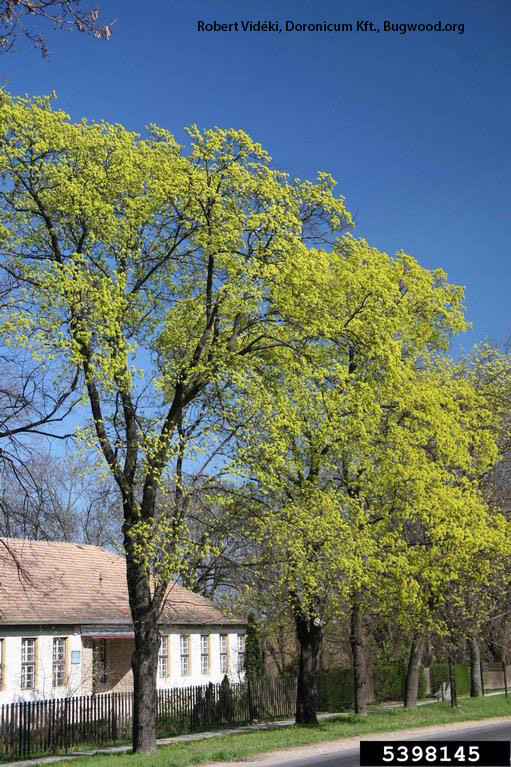
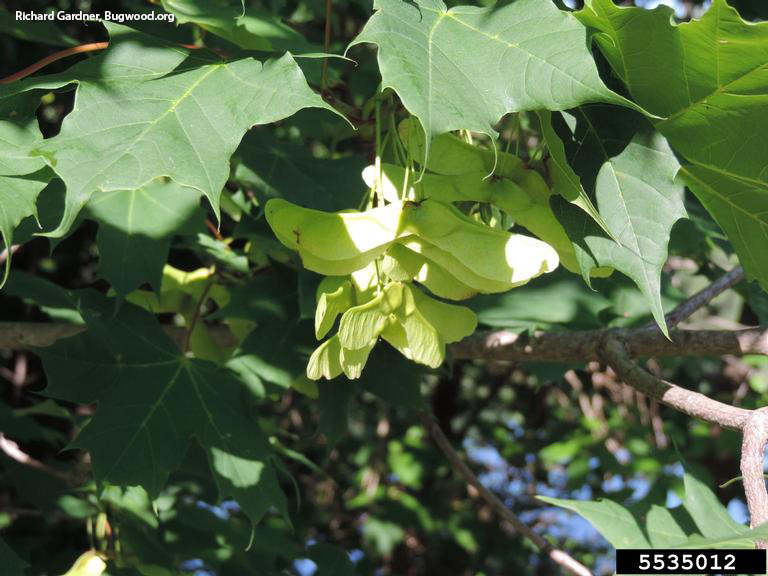
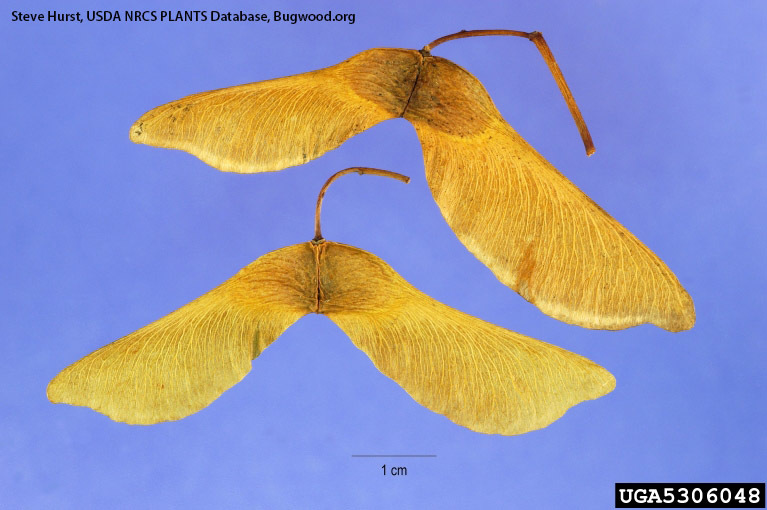
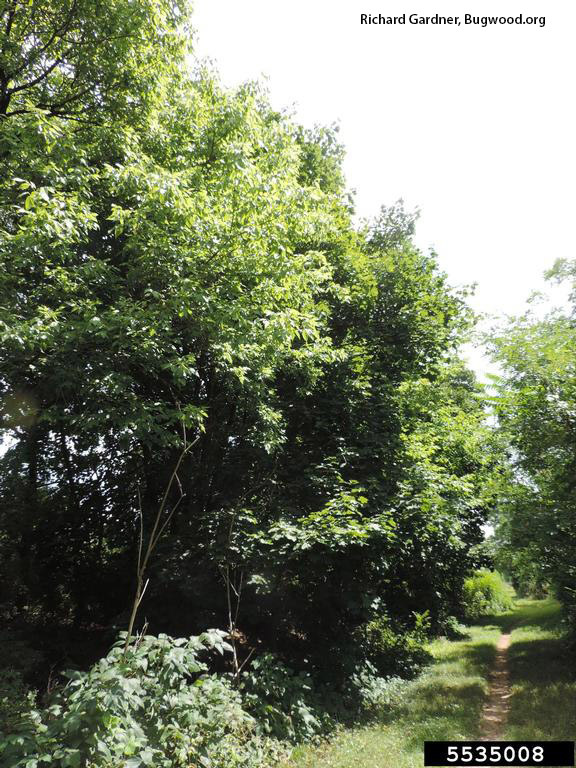
Norway maples are tall deciduous trees, growing up to 40-60+ feet tall with broad crowns. Large maple-shaped leaves are opposite each other on the stem and deciduous. Small yellow flowers bloom in the early spring and form samaras, with wings nearly at a 180 degree angle. It and its cultivars have been widely planted as a landscape tree throughout the United States. Over time it has spread and become a notable invader in the eastern US.
Flower Description
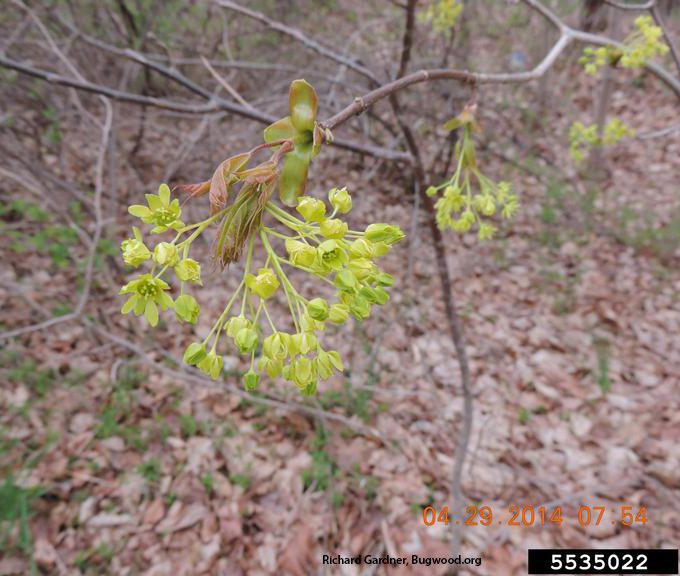
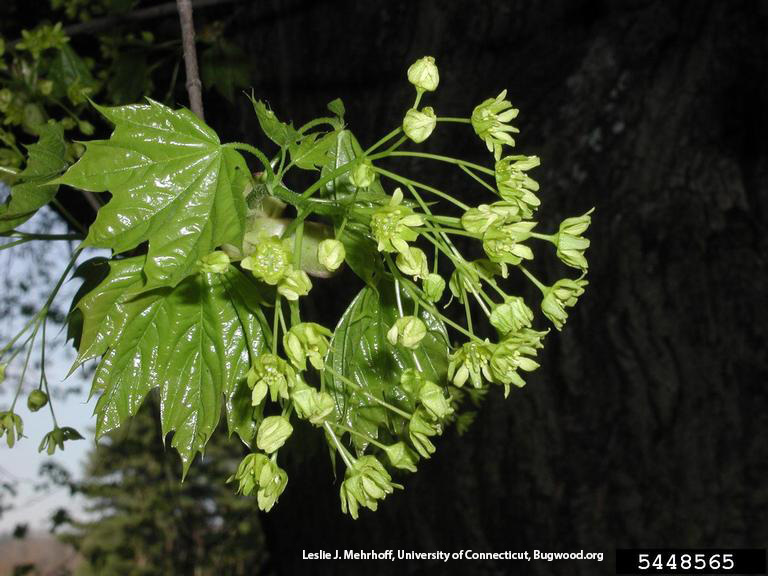
Upright, yellow-green, clusters of small 5-petaled flowers which have exerted stamens. Typically blooms in April to May, before leaves emerge. Trees take 20 to 30 years before reaching sexual maturity and being able to produce flowers.
Leaf description
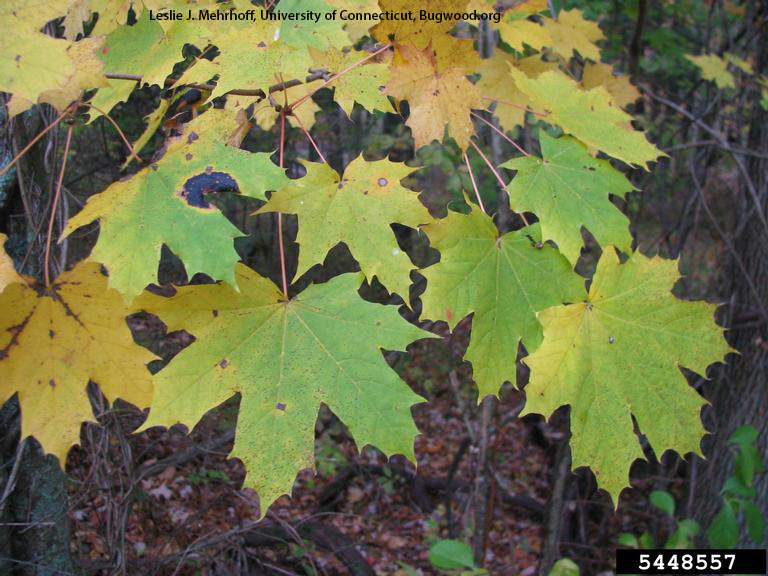
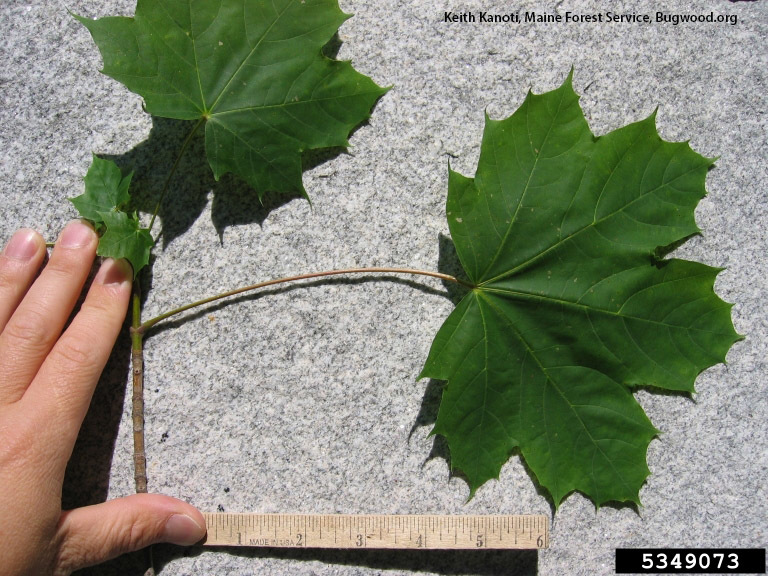
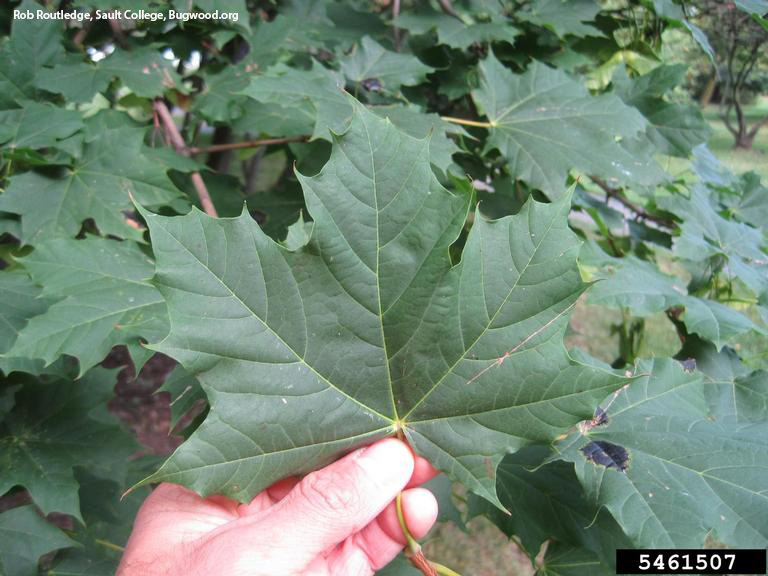
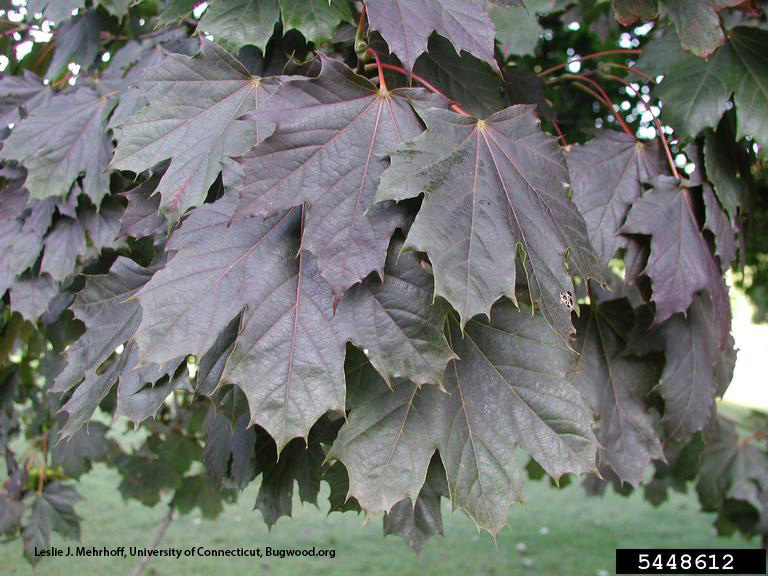
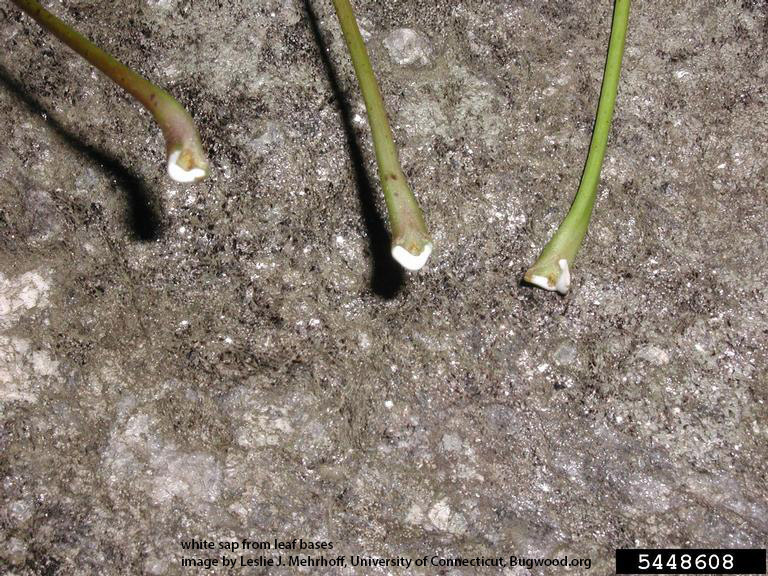
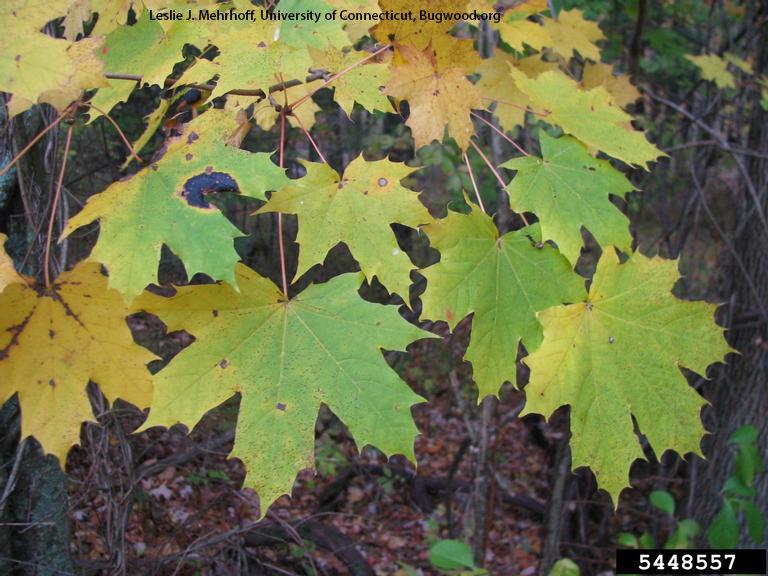
Typical maple-shaped leaves grow oppositely along branches and stems. When broken off of the plant, the stem produces a milky sap. Most cultivars have a dark green top side and a light green on the bottom side. Fall coloration is typically yellow, but several cultivars make red to orange hues.
Stem description
Trunk is generally upright and round. Young bark is grey and smooth, but develops yellow-ish ridges as the tree matures to a dark grey which is not scaly. Young twigs are stout, smooth, hairless, and branch tips are often forked with purple to red to green terminal buds.
Fruit Seed Description
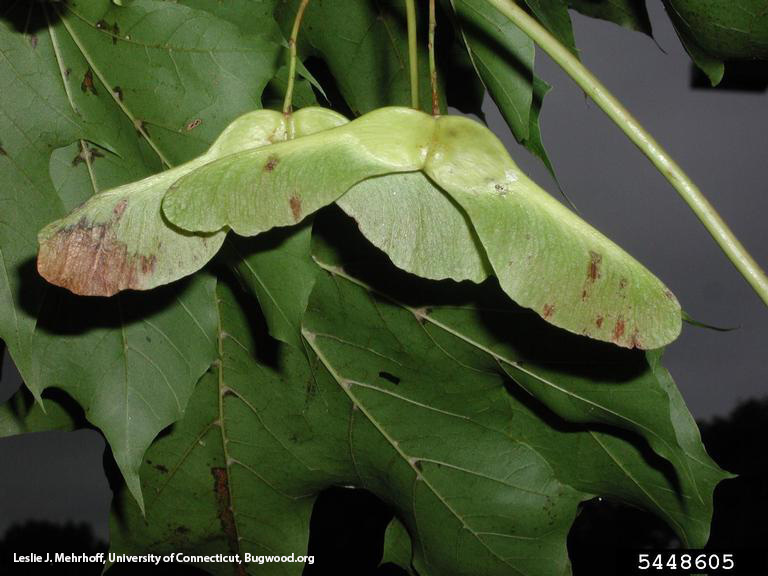
The dry fruit (samara) is of two sections, each with a seed that has a papery wing. The section with the seeds are connected at their bases and are hairless. The wings are in a wide angle from each other or sometimes almost horizontal. Trees take 20 to 30 years before reaching sexual maturity and being able to produce seed.
May Be Confused With
Bigleaf maple vs Norway maple vs Sycamore maple
Bigleaf maple (Acer macrophyllum) is the only native maple that looks similar to Norway maple. Bigleaf maple leaves get much larger than Norway maple leaves. Even when bigleaf maple leaves are a similar size to Norway maple leaves, our native maple leaves have much deeper lobes, while Norway maple leaf tips come to much sharper points. Bigleaf maple flowers are drooping bundles of green and white-green not-showy flowers, while Norway maple flowers are upright, yellow or yellow green, and twice the size of big leaf maple flowers. Bigleaf maple samaras are very fuzzy with stiff, sharp hairs on the not-winged parts, while Norway maple have entirely smooth samaras. Bigleaf maple bark is typically more reddish and frequently covered in moss and lichen, while Norway maple bark is more gray.
Sycamore maple (Acer pseudoplatanus) have less deeply lobed leaves, and the tips can be much more rounded than Norway maple. Sycamore maple bark has less vertical ridges and looks flakier than Norway maple
Sugar maple (Acer saccharinum) leaves are slightly rounded at the tips of each lobe, while Norway maple have pointed tips. Sugar maple samaras grow in much more of a horseshoe shape than Norway maple samaras. Sugar maple leaf buds are sharp and narrow, while Norway maple leaf buds are rounded and bulbous. Norway maple will release a milky sap when broken, but sugar maple’s sap is not milky in appearance. Comparison image here.
Where does it grow?
Norway maples are very shade tolerant, but can also grow in open areas. They grow in disturbed and undisturbed habitats, especially forests and forest edges, but also can grow in hot and dry areas.
Norway maples are widely planted as street trees in municipalities around North America, as well as being popular garden and ornamental trees in yards and other plantings. It is advisable to choose other species of tree for these plantings, as Norway maples have been recognized as highly invasive in natural areas, as well as damaging to infrastructure in street plantings.
How Does it Reproduce?
Seed, which spread easily on wind or float on water.
Can coppice and have root suckering after being cut down.
How Do I Control It?
Manual
Seedlings and saplings can be hand pulled or dug out of moist soil. Weed wrenches can be used on slightly larger saplings. Roots can be left exposed to dry and die.
Mechanical
Trees can be girdled with a chainsaw or other cutting tool, completely severing the outer layers of wood. The tree may survive and sprout from the trunk or roots left behind. A follow-up herbicide treatment can be used on this regrowth, or continued cutting will be necessary.
Cultural
Cover cut stumps with black plastic sheets or weed tarps, which can leave the stump behind to hold soil against erosion, while not allowing regrowth.
Minimize soil disturbance during control, to limit the amount of Norway maple seeds from germinating.
Chemical
Foliar spray can be done, while being careful to avoid drift and dripping onto desired vegetation.
Cut-stump, hack and inject, E-Z Ject, and basal bark treatment are all options on adult trees.
Herbicide tips for Norway maple from The Nature Conservancy.
For More Information
Our written findings on Norway maple.
Norway maple information on Invasive.org
UW Herbarium image database information on Norway maple
Additional Photos